
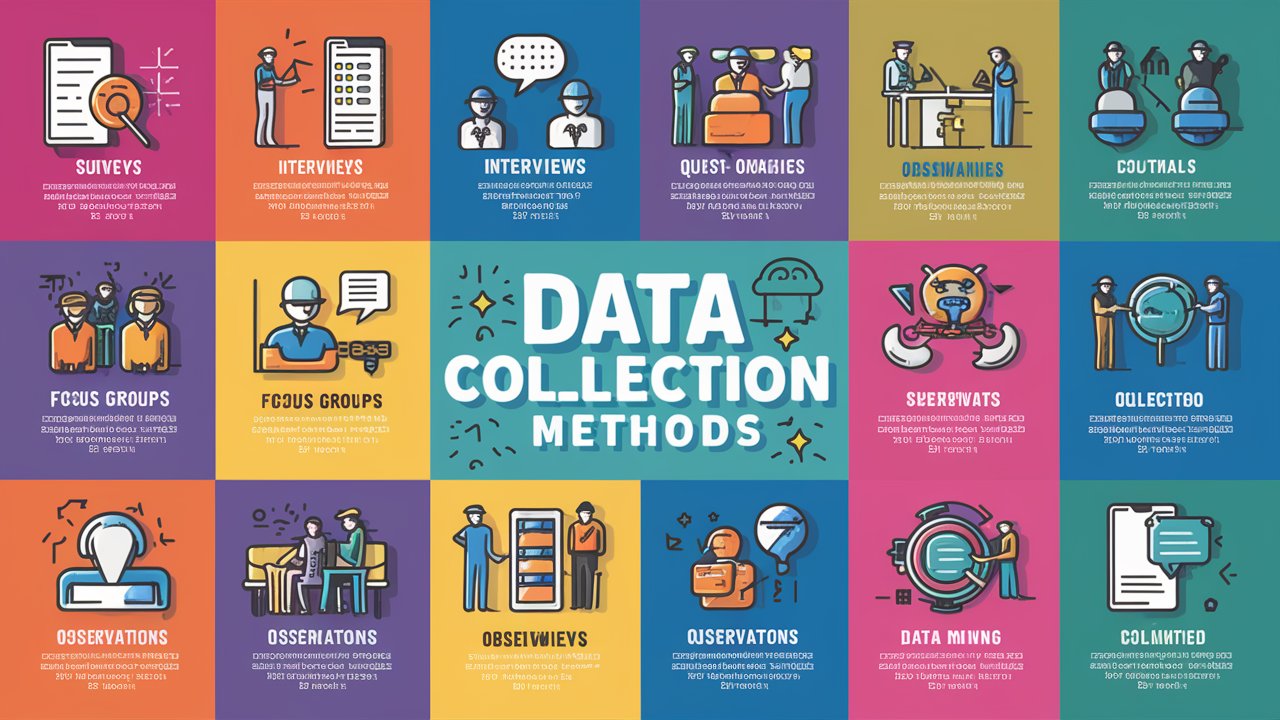
Data collection is the foundation of any research, analysis, or decision-making process. Whether in academic research, business intelligence, or social studies, the accuracy and reliability of data directly influence the quality of insights derived from it. Understanding various data collection methods is essential for selecting the right approach that aligns with research objectives, available resources, and the nature of the data required. This comprehensive guide explores the major data collection methods, their advantages, limitations, and best practices to ensure high-quality data gathering. Keywords such as data collection techniques, quantitative data collection, qualitative research methods, and data gathering tools are central to this discussion.
Major Data Collection Methods
1. Surveys and Questionnaires
Surveys and questionnaires are among the most widely used data collection methods in both quantitative and qualitative research. They involve structured sets of questions designed to gather information from a target population. Surveys can be conducted online, via phone, or in person, depending on the research context. Online surveys have become increasingly popular due to their cost-effectiveness and ability to reach large audiences quickly. The key to effective survey design lies in crafting clear, unbiased questions and ensuring that the sample size is representative of the population. This method is ideal for collecting numerical data, measuring opinions, and identifying trends across large groups.
2. Interviews
Interviews are a qualitative data collection method that allows for in-depth exploration of participants’ experiences, opinions, and motivations. They can be structured, semi-structured, or unstructured, depending on the level of flexibility required. Structured interviews follow a fixed set of questions, ensuring consistency across participants, while unstructured interviews allow for open-ended discussions that can reveal deeper insights. Semi-structured interviews strike a balance between the two. Interviews are particularly valuable in social sciences, market research, and user experience studies, where understanding human behavior and perception is crucial. However, they can be time-consuming and require skilled interviewers to minimize bias and ensure data reliability.
3. Observations
Observation involves systematically watching and recording behaviors, events, or phenomena as they occur in their natural setting. This method is commonly used in ethnographic research, psychology, and education studies. Observations can be participant-based, where the researcher actively engages with the environment, or non-participant, where the researcher remains detached. The advantage of observation is that it captures real-time data and provides context that might be missed in self-reported methods. However, it can be subjective and influenced by the observer’s interpretation, making it essential to use standardized observation protocols and multiple observers when possible.
4. Experiments
Experiments are a cornerstone of quantitative research, particularly in scientific and psychological studies. This method involves manipulating one or more variables to observe their effect on other variables, allowing researchers to establish cause-and-effect relationships. Experiments can be conducted in controlled laboratory settings or in the field, depending on the research goals. The strength of experimental data collection lies in its ability to produce highly reliable and replicable results. However, experiments can be limited by artificial conditions that may not reflect real-world scenarios. Proper experimental design, including randomization and control groups, is critical to ensure validity and minimize bias.
5. Focus Groups
Focus groups are a qualitative data collection technique that gathers insights from a small group of participants through guided discussions. A moderator facilitates the conversation, encouraging participants to share their thoughts, feelings, and experiences about a specific topic. This method is particularly useful in marketing research, product development, and social studies, where understanding group dynamics and collective opinions is valuable. Focus groups provide rich, detailed data but can be influenced by dominant participants or groupthink. Effective moderation and careful participant selection are essential to obtain balanced and meaningful results.

6. Case Studies
Case studies involve an in-depth examination of a single subject, organization, event, or phenomenon. This method provides comprehensive insights into complex issues that cannot be captured through quantitative approaches alone. Case studies often combine multiple data collection techniques, such as interviews, observations, and document analysis, to build a holistic understanding. They are widely used in business, education, and healthcare research. While case studies offer detailed contextual analysis, their findings are often limited in generalizability. Researchers must clearly define the scope and purpose of the case study to ensure its relevance and rigor.
7. Document and Content Analysis
Document and content analysis involve systematically reviewing existing materials such as reports, articles, social media posts, or archival records to extract relevant information. This method is particularly useful for historical research, media studies, and policy analysis. Content analysis can be quantitative, focusing on frequency counts and patterns, or qualitative, emphasizing meaning and interpretation. The advantage of this method is that it uses readily available data, reducing the need for direct interaction with participants. However, researchers must critically assess the credibility and context of the sources to avoid misinterpretation.
8. Online and Digital Data Collection
With the rise of digital technology, online data collection methods have become increasingly prevalent. These include web analytics, social media monitoring, mobile app tracking, and online behavior analysis. Digital data collection provides access to large volumes of real-time data, enabling businesses and researchers to identify trends and patterns quickly. However, ethical considerations such as privacy, consent, and data security are paramount. Implementing transparent data policies and adhering to data protection regulations ensures responsible and ethical data collection practices.
Conclusion
Selecting the right data collection method is a critical step in ensuring the accuracy, reliability, and validity of research findings. Each method—whether quantitative or qualitative—offers unique strengths and limitations that must align with the research objectives and available resources. Combining multiple methods, known as triangulation, can enhance data credibility and provide a more comprehensive understanding of the research problem. As technology continues to evolve, data collection techniques will become more sophisticated, offering new opportunities for researchers and organizations to gather meaningful insights.
Frequently Asked Questions (FAQ)
1. What is the difference between quantitative and qualitative data collection methods?
Quantitative methods focus on numerical data and statistical analysis, while qualitative methods explore non-numerical data such as opinions, experiences, and behaviors.
2. How do researchers choose the best data collection method?
The choice depends on research objectives, the type of data needed, available resources, and the desired level of accuracy and depth.
3. What are the main challenges in data collection?
Common challenges include sampling bias, data accuracy, respondent honesty, ethical concerns, and resource limitations.
4. Can multiple data collection methods be used in one study?
Yes, combining methods—known as mixed-methods research—can provide a more comprehensive understanding by integrating both quantitative and qualitative data.
5. Why is ethical consideration important in data collection?
Ethical practices ensure participant privacy, informed consent, and data security, maintaining the integrity and credibility of the research process.