
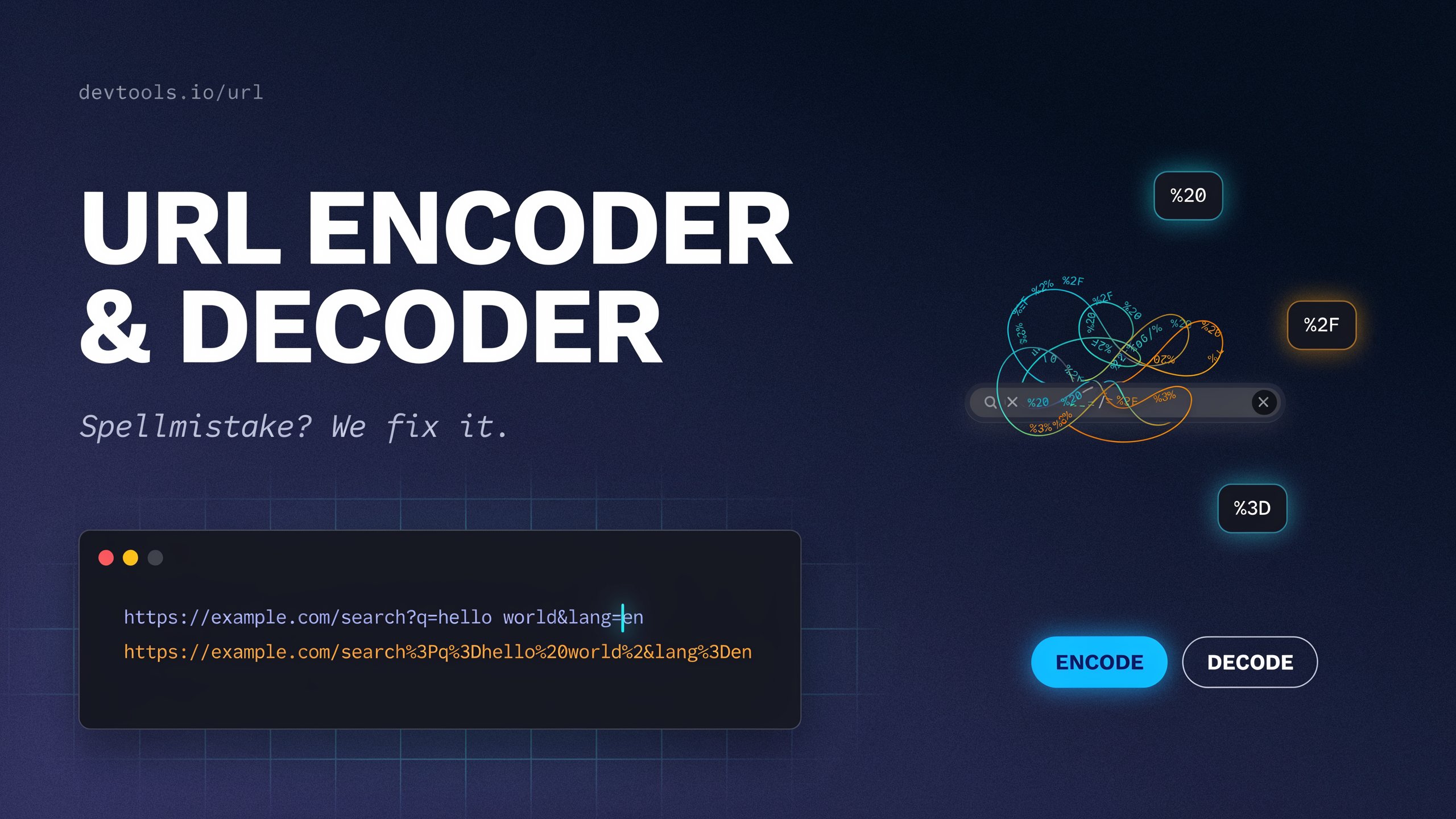
The internet relies on URLs to connect users with websites, applications, APIs, and online services. Every time you click a link, submit a form, or perform a search, your browser sends a URL that helps locate the requested resource. However, URLs cannot safely contain every possible character. Spaces, punctuation marks, symbols, and certain non-English characters must first be converted into a standard format that web browsers and servers understand. This process is known as URL encoding, while converting the encoded text back into its original form is called URL decoding.Many users searching for “URL Encoder and Decoder Spellmistake” are either looking for a URL encoding tool after typing the phrase incorrectly or trying to understand why encoded URLs sometimes appear confusing.
Misspelled search queries are common, especially when technical terms such as “encoder,” “decoder,” “encoding,” and “decoding” are involved. Fortunately, the spelling mistake does not change the underlying concept. Whether you are a beginner learning web development or an experienced developer troubleshooting URL issues, understanding URL encoding and decoding is essential for creating reliable, secure, and user-friendly web applications.
What Is a URL Encoder?
A URL encoder is a tool or software utility that converts special characters into a format that can be safely transmitted over the internet. Instead of sending spaces or reserved characters directly, the encoder replaces them with percent-encoded values. For example, a space becomes %20, the ampersand symbol (&) becomes %26, and a question mark (?) becomes %3F when necessary.
This conversion ensures that browsers, web servers, and APIs interpret URLs correctly. Without encoding, special characters may be mistaken for control symbols rather than actual data, leading to broken links, incorrect search results, or failed requests.
What Is a URL Decoder?
A URL decoder performs the opposite operation. It converts encoded values such as %20, %2F, or %3A back into readable characters like spaces, slashes, and colons. Developers commonly use URL decoders while debugging applications, inspecting API requests, analysing website traffic, or reading encoded query parameters.
Decoding makes complex URLs much easier to understand because it restores the original human-readable text without altering the information contained within the address.
What Does “URL Encoder and Decoder Spellmistake” Mean?
The phrase “URL Encoder and Decoder Spellmistake” generally refers to users searching for URL encoding or decoding tools while accidentally misspelling one or more words in the search query. Examples include typing url encorder, url decorder, url encode decoder, url spell mistake, or similar variations. Search engines are usually intelligent enough to recognise these mistakes and still return relevant results.
In other situations, users may believe that an encoded URL itself contains a spelling mistake because it includes unfamiliar character sequences such as %20, %3D, or %2B. These symbols are not errors—they are simply part of the standard URL encoding format used across the web.
Why URL Encoding Is Important
URL encoding plays a vital role in modern web communication because it prevents ambiguity when transmitting data. Browsers, web servers, databases, and APIs all depend on standardised URL formatting to exchange information accurately. Without encoding, reserved characters could interrupt the structure of a URL and cause incorrect interpretation of parameters.
Encoding also improves compatibility between different operating systems, programming languages, browsers, and international character sets. Websites that support multiple languages rely heavily on encoding to ensure characters outside the basic English alphabet are transmitted correctly.
Common URL Encoding Mistakes
Although URL encoding is straightforward, developers frequently encounter avoidable mistakes. One common error is forgetting to encode spaces, resulting in invalid or broken URLs. Another issue occurs when URLs are encoded multiple times, producing values that no longer decode correctly. Incorrectly mixing encoded and unencoded characters within the same URL can also create unexpected behaviour.
Some users mistakenly encode an entire URL when only the query parameter requires encoding, while others decode data more than once, corrupting the original content. Understanding when and where encoding should be applied helps avoid these problems.
Examples of URL Encoding
Consider the following text:
Original Text
Hello World & FriendsEncoded Version
Hello%20World%20%26%20FriendsAnother example:
Original URL
https://example.com/search?q=web developmentEncoded Query
https://example.com/search?q=web%20developmentThese examples demonstrate how spaces and special characters are converted into percent-encoded values so the browser can process them safely.
Common Characters Used in URL Encoding
Several characters require encoding because they have special meanings within URLs. Spaces become %20, quotation marks become %22, hash symbols become %23, percent signs become %25, ampersands become %26, plus signs may appear as %2B, slashes become %2F when treated as data, colons become %3A, semicolons become %3B, question marks become %3F, and equals signs become %3D. Understanding these conversions helps developers read encoded URLs more confidently and diagnose problems more quickly.
Best Practices for Using URL Encoders and Decoders
When working with URLs, always encode user input before placing it into query parameters or API requests. Use trusted programming language libraries or reliable online URL encoding tools rather than manually replacing characters. Test encoded URLs carefully to ensure they decode back to the original text without losing information.
Avoid double encoding unless specifically required, and never assume that every encoded string should be decoded repeatedly. Maintaining consistency throughout your application reduces bugs, improves compatibility, and strengthens security.
Benefits of URL Encoding
Proper URL encoding offers many advantages beyond simply making URLs valid. It improves data integrity, ensures consistent behaviour across browsers, supports international languages, enhances compatibility with APIs, prevents malformed requests, and reduces the risk of parsing errors. Encoding also contributes to better security by preventing certain input-related issues and ensuring special characters are handled in a predictable manner.
For developers, marketers, SEO professionals, and website administrators, understanding URL encoding simplifies troubleshooting and improves the reliability of websites and web applications.
Conclusion
The phrase “URL Encoder and Decoder Spellmistake” often represents a misspelled search for information about URL encoding and decoding rather than a technical issue with URLs themselves. URL encoding converts special characters into a safe, standardised format that browsers and servers can interpret correctly, while URL decoding restores encoded text to its original readable form. Mastering these concepts helps developers build reliable web applications, troubleshoot encoding issues, and ensure data is transmitted accurately across the internet. By following best practices, avoiding common encoding mistakes, and using trusted encoding tools, you can work confidently with URLs in virtually any web development project.
Frequently Asked Questions (FAQ)
1. What is a URL encoder?
A URL encoder converts special characters into percent-encoded values so they can be transmitted safely in a URL.
2. What is a URL decoder?
A URL decoder converts encoded values such as %20 back into their original readable characters, such as spaces.
3. What does “URL Encoder and Decoder Spellmistake” mean?
It usually refers to a misspelled search query for URL encoding or decoding tools rather than an actual encoding error.
4. Why is URL encoding necessary?
Encoding prevents reserved characters from being interpreted incorrectly and ensures URLs work reliably across browsers, servers, and APIs.
5. What is percent encoding?
Percent encoding is the standard method of replacing reserved characters with a percent sign followed by two hexadecimal digits representing the character.
6. Can incorrect URL encoding cause website problems?
Yes. Incorrect encoding can result in broken links, failed API requests, incorrect search parameters, missing data, or unexpected server responses.
7. Does URL encoding affect SEO?
Proper URL encoding helps search engines crawl and interpret URLs correctly, especially when URLs contain spaces, symbols, or international characters.
8. Should I use an online URL encoder or a programming library?
Both are useful. Online tools are convenient for quick conversions, while built-in programming libraries are recommended for production applications because they provide consistent, standards-compliant encoding and decoding.